From open source to an intelligent, reusable government capability
A strategic entry point for choosing the right government transformation path, enterprise product, governed open source, custom development, integration, automation or AI.

The real question is not whether the code is open
Open source creates value only when it becomes a governed institutional asset: its licences and components are known, upgrades remain possible, operations can be audited, data can be moved and essential knowledge survives a change of team or supplier.
A low-risk decision before a large commitment
Begin with a focused executive workshop, an assessment of the current environment, integrations and risks, then one bounded project. Write the success measures and exit gate before implementation, so expansion becomes an evidence-based decision rather than an assumption.
Open source is one route, not a constraint on the answer
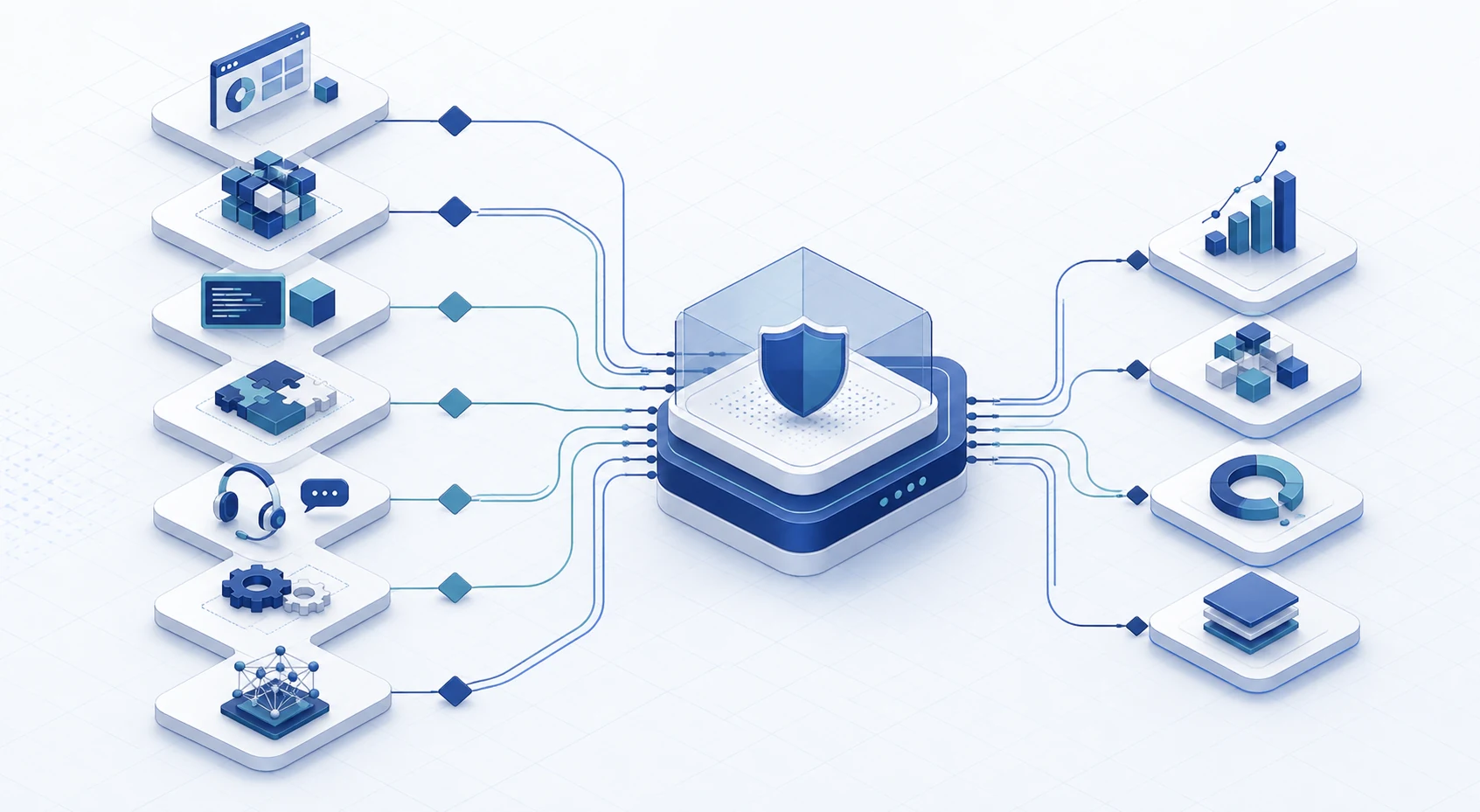
We start with the entity’s need, not a licence type or product name. The right path may be a Labiba® enterprise product, a Talaphony® communications platform, governed open source, custom development, integration, automation, AI, deployment services or a carefully designed combination. Business Field brings these tracks under one delivery responsibility.
From available code to a governed government asset
Where open source is the right choice, the guide traces a deliberate journey: Open Source, then a Governed Product with identity, access, security, updates and documentation, then a Reusable Government Asset that can be transferred, developed and reused where policy and scope permit.
What Labiba® adds
Labiba® is not a chat window placed over another screen. It adds a conversational AI layer connected to real services, authorised sources, clear permissions and records that can be reviewed, shortening the path to a service or answer while keeping human review and final authority where they belong.
What a successful initial implementation should make visible
A credible initial implementation should produce a current-state report, a decision matrix, a governed trial environment, one real integration, an operations and security pack, an initial evidence pack, and a documented choice to expand, revise or exit.
Six safeguards for continuity
A clear exit gate, source and documentation handover under the agreed contract and licences, no artificial lock-in, a component and licence register, an upgrade-conscious design, and auditable operations with tested recovery protect the decision as much as the technology.
One guide for several decision-makers
Executives can read the opening pages for the decision, value and safeguards. Digital transformation, IT, security, procurement and operations teams can use the remainder as a structured reference for assessment, architecture, phased implementation, contracting, acceptance and continuity.
A professional boundary
This is a general executive publication, not legal advice or government endorsement. Suitability requires an independent review of scope, licences, security, hosting and integration. No system by itself guarantees a score or result in an official assessment.